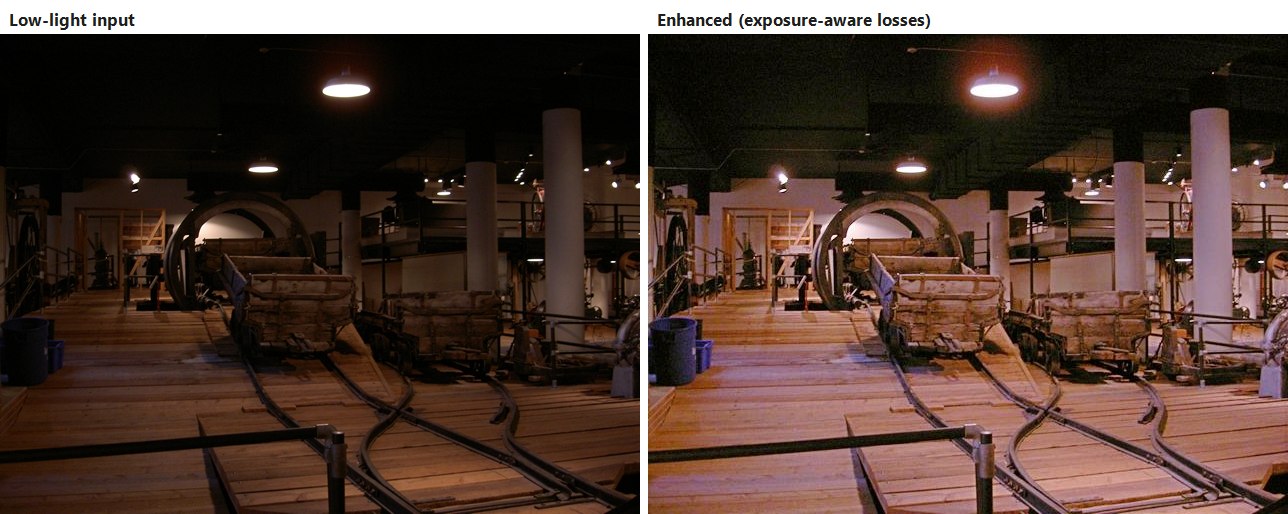
Low-light enhancement is usually optimised for human perception and then attached to a detector that had no say in the objective. This work studies enhancement whose only consumer is the detector, evaluated with multi-seed YOLOv8 experiments on ExDark, gradient-conflict analysis, and TP/FP/FN error decomposition.
@article{chen2026dolenet,title={DOLENet: Detection-Oriented Low-Light Enhancement},author={Chen, Yujie and Jung, Minpo},journal={Manuscript in preparation},year={2026},}
MSc
A Study on Deep Learning-Based Low-Light Image Enhancement
Zero-reference training, local illumination balancing and shadow recovery without additional inference cost. Introduces two exposure-aware losses on the Zero-DCE framework — a region-specific dark-region exposure loss and a highlight-preservation loss — benchmarked against Retinexformer and RUAS on both no-reference (NIQE, BRISQUE, LOE) and full-reference (PSNR, SSIM, LPIPS) metrics.
@mastersthesis{chen2026thesis,title={A Study on Deep Learning-Based Low-Light Image Enhancement},author={Chen, Yujie},school={Youngsan University},year={2026},}